SB Review - May 2026
May 30, 2026 (5m ago)0 views
Final note ⭐️⭐️
PSG set the tone before the World Cup summer
Paris Saint-Germain overcame Arsenal at the end of an exhausting Champions League final, securing their second consecutive Champions League title. It gives even more weight to this month’s broader conversations around football, brand power and global attention.
Sport Business, Sponsorship & the battle for attention ahead of the World Cup.
With less than a month to go before the FIFA World Cup 2026, May was dominated by one central theme: the fight for fan attention.
Whether through sponsorship, advertising, fan engagement platforms or content strategies, rights holders and brands are preparing for what could become the largest sporting conversation in history.
At the same time, the industry continues to grapple with major structural challenges: changing fan consumption habits, financial pressures on clubs, and the need to create sustainable value beyond media rights.
Here are the key stories from May.
Sponsorship
11/05 — FIFA ends its historic relationship with Panini
One of the longest-running partnerships in sport is coming to an end.
The partnership between FIFA and Panini will conclude in 2031, with Fanatics set to take over.
This is more than a licensing change. It reflects Fanatics’ ambition to become a fully integrated sports commerce platform, spanning:
- merchandise
- collectibles
- betting
- fan experiences
- digital commerce
The battle for fan ownership increasingly extends far beyond the stadium.
16/05 — Marseille × Monster Energy
Olympique de Marseille announced a partnership with Monster Energy.
The agreement includes:
- product presence at the stadium
- matchday activations
- fan experiences
- cultural initiatives connecting different sports communities
The partnership highlights a growing trend among clubs: moving away from traditional sponsorship inventory and towards community-driven activations built around lifestyle and culture.
18/05 — FIFA strengthens ties with Saudi Arabia’s Public Investment Fund
The Public Investment Fund has become an official supporter of the FIFA World Cup 2026 across North America and Asia.
With more than $900bn in assets under management, the PIF is now one of the world’s largest sovereign wealth funds.
The partnership further strengthens Saudi Arabia’s influence within global football ahead of the country’s hosting of the FIFA World Cup 2034.
18/05 — Serie A × Polymarket
Following agreements with LaLiga and MLS, Polymarket has become the official and exclusive prediction market partner of Serie A in the United States.
The agreement grants:
- access to official league data
- use of Serie A intellectual property
- integration with data services provided by Genius Sports
Polymarket is rapidly building a significant position across football, despite continuing regulatory uncertainty in several markets.
Further reading
May’s deals show how sponsorship is being rebuilt around fan ownership, culture, and data. From Fanatics taking over Panini to Monster and Polymarket entering football, rights holders are no longer selling visibility alone — they are competing to own the full fan relationship.
Advertising & Media — The Road to World Cup 2026
Adidas: from football brand to cultural platform
If there is one campaign that perfectly captures the changing nature of sports marketing, it is Adidas’ latest World Cup campaign.
The film opens with an unexpected conversation between Timothée Chalamet and Bad Bunny. The message is immediately clear: this is not a football commercial. It is a pop culture campaign that happens to use football as its backdrop.
Alongside football icons such as Lionel Messi, Zinedine Zidane and David Beckham, Adidas also features a new generation of stars: Jude Bellingham, Lamine Yamal and Trinity Rodman.
What makes the campaign particularly interesting is that it builds on Adidas’ broader North American strategy. Back in late 2025, the brand launched “La Preparación Americana”, positioning the World Cup not as a tournament but as a cultural movement spanning an entire continent.
This new chapter moves even further away from sport and deeper into entertainment and lifestyle. The inclusion of Chalamet and Bad Bunny is not accidental: Bad Bunny brings Hispanic-American cultural relevance, while Chalamet connects with a global Gen Z audience that may be more interested in fashion and entertainment than football itself.
Perhaps the most revealing element of the campaign was the appearance of a fictional lavender football shirt featuring “Chalamet 26”. Within hours, fans were demanding the product online. The advertisement effectively became a merchandise drop teaser.
The strategic lesson. For years, sports sponsorship was built around sporting performance. Today, brands increasingly seek cultural relevance rather than sporting relevance alone. Athletes remain important, but their ability to create cultural conversations is becoming equally valuable. Adidas is no longer positioning itself solely as a sportswear company — it is positioning itself as a cultural brand that happens to operate through sport.
Lay’s: using sponsorship to drive sales, not awareness
While Adidas is playing the cultural game, Lay’s is pursuing a different objective.
Lay’s became an official FIFA partner in 2024, entering territory historically dominated by Coca-Cola. The contrast between both strategies is fascinating.
Coca-Cola continues to focus on:
- emotional storytelling
- global trophy tours
- collectible packaging
- long-term brand equity
Lay’s, meanwhile, is using its FIFA rights as a commercial activation platform. Its latest campaign launches 40 flavours inspired by countries participating in the World Cup. Each flavour tells the story of a country, a cuisine and a football culture.
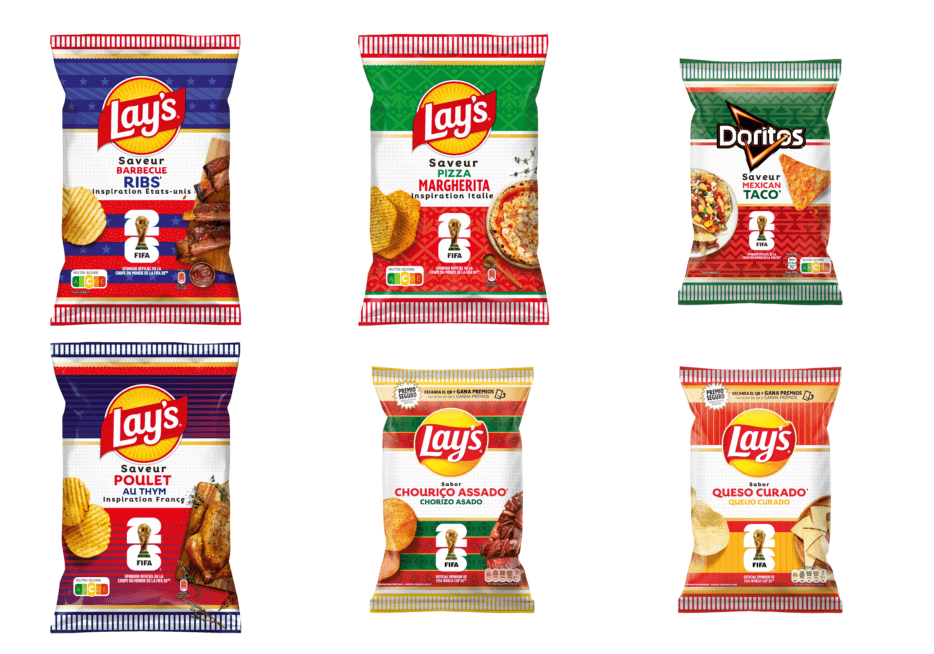
This is not primarily a branding exercise. It is a retail strategy: the sponsorship provides consumers with a reason to purchase.
Sponsorship as a sell-through engine. One particularly interesting aspect is Lay’s distribution strategy. Several products have been launched through exclusive retail agreements, giving retailers differentiated SKUs and enhanced promotional opportunities. The approach demonstrates a key shift: rights holders increasingly want commercial proof, not just visibility. The most successful sponsors are no longer those generating the biggest awareness metrics — they are those able to translate sponsorship into measurable sales performance.
Building first-party data through football. Lay’s has also developed sophisticated fan engagement mechanics. The “No Lay’s, No Game” initiative uses a WhatsApp-based content experience featuring Lionel Messi, David Beckham, Alexia Putellas, Thierry Henry and Steve Carell. Meanwhile, the “Fan of the Match” campaign will award premium match tickets to 104 winners — one for every match of the expanded tournament. The objective is clear: collect first-party data, build CRM assets, and strengthen long-term consumer relationships. For many sponsors, data capture is now becoming just as important as visibility.
Full analysis: Lay’s × FIFA 2026 — sponsorship as a sell-through machine (Sportsmarketing.fr).
Powerade: building a four-year activation cycle
As the official sports drink of the World Cup, Powerade launched its most ambitious campaign to date: Power Your Fate.
The campaign features Lamine Yamal and Rodrygo. The pairing is strategic: Yamal represents the future of European football, while Rodrygo delivers strong relevance across Latin America.
The campaign extends far beyond traditional advertising. It includes:
- in-stadium activations
- retail programmes
- social content
- creator collaborations
- appearances at events such as Fanatics Fest
Most importantly, it forms part of a broader four-year strategy extending through the 2027 Women’s World Cup and the 2028 Los Angeles Olympic Games.
The era of one-off sponsorship activations is fading. Brands increasingly think in long-term ecosystem cycles.
Further reading
The biggest World Cup campaigns are diverging by intent: Adidas chases cultural relevance, Lay’s chases retail performance, and Powerade builds a multi-year activation cycle. The common thread: sponsorship is increasingly judged on the role it plays in fans’ lives, not on exposure alone.
Sport Business
11/05 — Fan experience becomes the new battleground
The live match is no longer the beginning of the fan journey. It is only one touchpoint within a broader entertainment ecosystem.
The Ligue de Football Professionnel continues to expand its digital ecosystem following the acquisition of MPG in 2022. Through the official Ligue 1 app, MPG and Mon Petit Prono, the league collects fan data and shares insights with clubs to strengthen supporter engagement.
The objective is increasingly clear: own the fan relationship.
Technology, content and data are becoming essential assets in football’s commercial model. Yet the challenge remains balancing innovation with authenticity. As many executives highlighted this month: technology should not replace emotion — it should amplify it.
18/05 — Kearney: the global sports industry could exceed $600bn by 2030
According to a new report from Kearney, the global sports industry is expected to grow from $417bn in 2025 to more than $600bn by 2030.
The report identifies five major value creation drivers:
- commercial revenues and sponsorship
- fan engagement and fan data monetisation
- integrated digital ecosystems
- technology and AI
- operational and financial professionalisation
Perhaps the most important finding: younger fans increasingly follow athletes rather than clubs — a trend that directly echoes the conclusions of April’s Athlete Brand Economy report.
30/05 — Fan fatigue: the industry’s next challenge
As rights holders compete for attention, a new concern is emerging: fan fatigue.
Research suggests:
- only one in four Gen Z consumers watches live sport weekly
- 90% prefer highlights to full matches
The issue is not declining interest in sport. Rather, it is an oversupply of content competing for limited attention.
The implication is significant. The future of sports marketing may depend less on maximising exposure and more on delivering relevance. Brands and rights holders must increasingly earn attention rather than interrupt audiences to capture it.
This is one reason why broadcasters such as M6 are turning to creators such as Michou to engage younger audiences around the World Cup.
Further reading
The industry is scaling fast — potentially beyond $600bn by 2030 — but growth is colliding with fan fatigue. The next competitive edge is not reach, but relevance: owning the fan relationship and earning attention rather than buying it.
Merchandising
PSG pays tribute to the Hechter era
The new Paris Saint-Germain home shirt pays tribute to the iconic Hechter design.
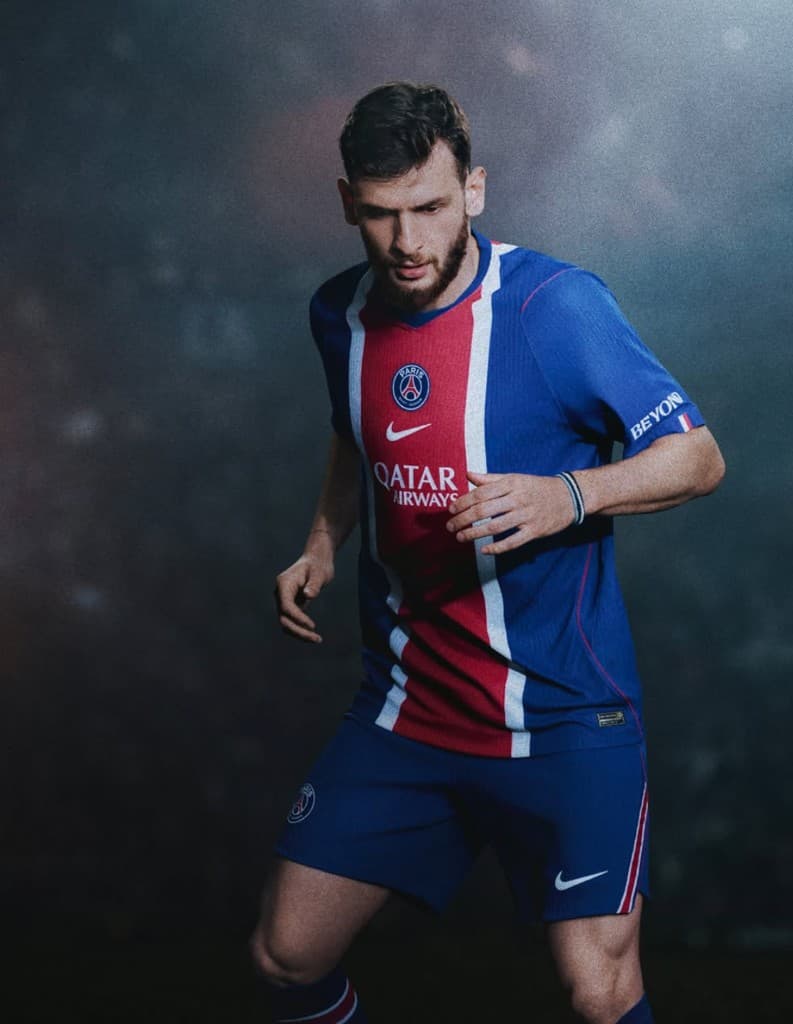 Paris Saint-Germain new home shirt paying tribute to the iconic Hechter design
In an era where football shirts increasingly serve as lifestyle products, heritage remains one of the most powerful storytelling tools available to clubs.
Levi’s × FFF
Levi’s and the French Football Federation unveiled a capsule collection ahead of the World Cup.
Designed with Paris-based Pablo T-Shirt Factory, the collection includes:
- trucker jackets
- shorts
- a bandana
- a tote bag
The collaboration further demonstrates how football is increasingly influencing fashion and lifestyle sectors.
Further reading
Kits are becoming culture: PSG leans on heritage while Levi’s × FFF pushes football deeper into fashion. Merchandising is no longer an afterthought — it is a storytelling and lifestyle platform in its own right.
Key takeaways
- 1 The World Cup is already being fought off the pitch. Adidas, Lay’s and Powerade are not simply promoting a tournament — they are competing to own the cultural narrative around it.
- 2 Fan attention is becoming the industry’s scarcest resource. From fan experience platforms to creator partnerships, the challenge is no longer reaching fans — it is remaining relevant to them.
- 3 Sponsorship is becoming more accountable. The most sophisticated partnerships increasingly focus on first-party data, retail performance and measurable business outcomes rather than visibility alone.
As World Cup 2026 approaches, one thing is becoming increasingly clear: the brands that win will not necessarily be those with the biggest rights packages, but those that create the most meaningful role in fans’ lives.
SB Review returns at the end of June with another round-up of the sport business stories shaping the industry.